🥽🤌 Quick First Impressions of the Vision Pro
Veni, vidi, vr
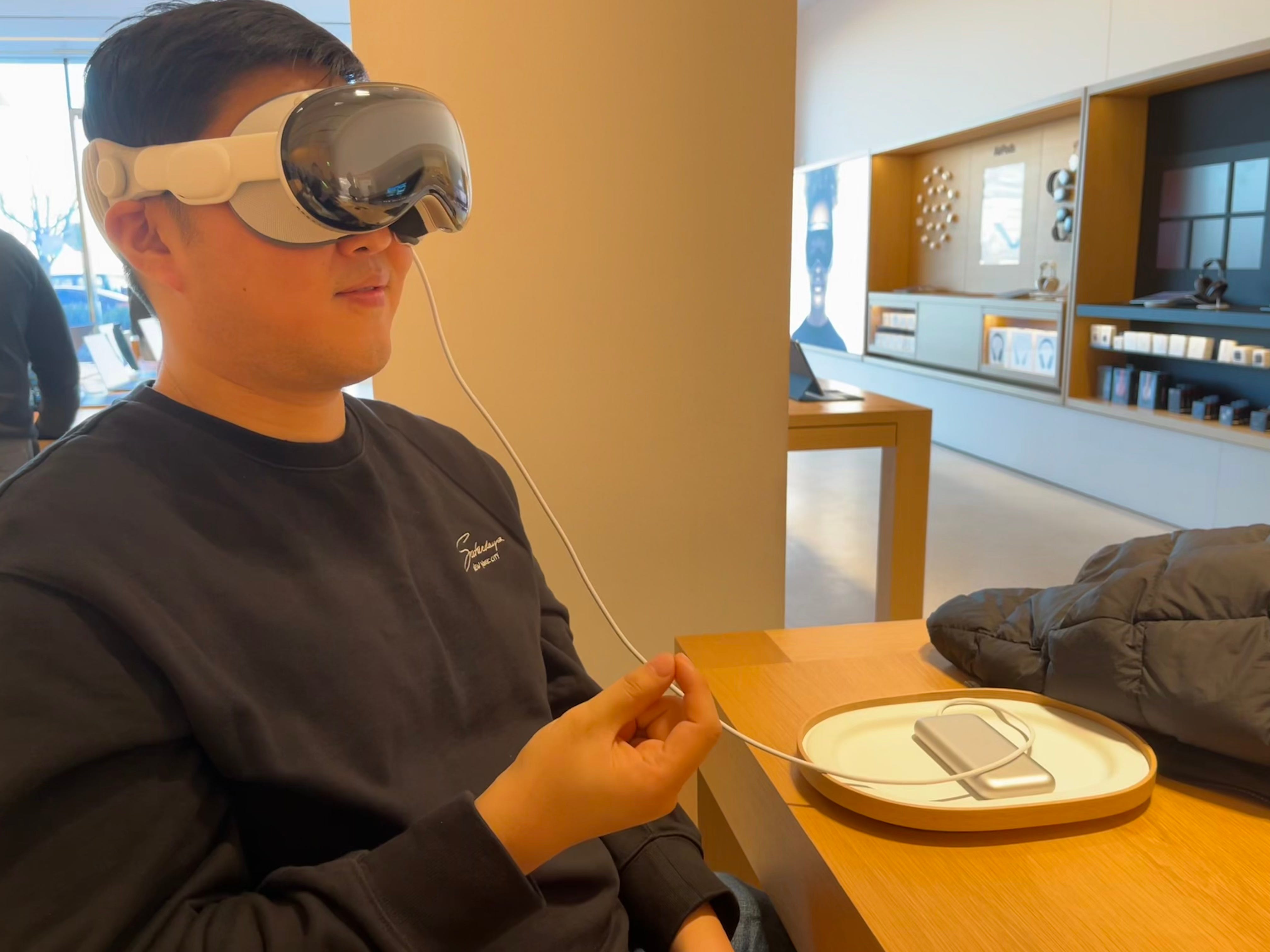
I went to the Apple Store today to try a demo for the new Vision Pro, Apple’s new “spatial computing” device. I’ll be very surprised if it doesn’t play a significant role in how we entertain ourselves over the next 5 to 10 years.
UI
The whole thing was very cool but the most impressive part of the experience was how well Apple’s new visionOS interface works. Sensors inside the headset track your eyes and they serve as the cursor. You “click” by bringing your finger and your thumb together. You zoom in and out by doing that with both hands and moving them around. It took a few times to get comfortable but by the end, I was super excited about how seamless the interactions were. Even knowing about the sensors, it felt like it was reading my thoughts, not my eyes. There were a few times when it wouldn’t highlight the exact thing I was looking at right away but those were the exceptions, not the rule. The hand gestures too didn’t have to be exaggerated at all and I could do them comfortably above my lap. Some of the interactions required me to use a digital crown on the top right. If you have an Apple Watch, how to use it feels very intuitive but finding it took me a few tries not being able to see it.
AR by way of VR
So the goggles are opaque and not see-through.1 That being said, the Vision Pro headset feels like an AR headset where you can see everything in front of you. I passed my “hands” in front of my “eyes” a couple of times and I couldn’t really tell I wasn’t actually “seeing” them.2 I kept on looking at the screen of the iPad next to me too thinking “that’s a screen” and then thinking “everything I’m seeing is a screen” and not only that but the iPad was showing everything I was seeing.
I have the Meta Quest 2 and the sharpness and clarity on these were way better. The field of vision is a bit limited still but it only felt like a constraint in some of the 180 photos or panoramas I got to look at. So for the most part your virtual environment looks exactly like your natural environment. There were a few focus environments you could immerse yourself into, like a tranquil forest, acting like the visual equivalent of a focus playlist. And like the the way AirPods work, if someone came near me or if I started talking to them their face would show through those immersive environments in a way that felt natural.
Use cases
Now for the really cool stuff. I can see this already replacing light work or reading on MacBooks and iPads. Not sure you’ll ever be able to do more heavy-duty tasks purely with the eye-hand interface but with a physical keyboard and mouse-like tool, I don’t see why you couldn’t do everything on here that you do on a Mac. What I’m very excited for is watching TV and movies on this thing. You can put up a window that makes it feel like you’re watching something in a home theater. I can’t imagine being able to do that on a plane.
I chuckled when Apple slipped in a bit of MLS and Inter Miami content into the demo along with a clip from a baseball game. I’m not even a baseball or soccer fan but if this is the future of sports viewing, our relationship to sports are about to fundamentally change and sports broadcast rights are going to go up and up. Football games are in my opinion not all that fun to watch in person, even from the field, and at home you’re not going to feel the thrilling collective experience that’s only possible at a stadium. The short clips I saw on here made me feel like I was in the dugout at a baseball field and just behind the goal at an Inter Miami game. Just incredible. Taylor Swift can have her box.
At the same time, as good as the Vision Pro will be for sports, it may be the device that ultimately kills the theatrical film experience. I’ve always believed that regardless of streaming, the theater experience would survive, however diminished, because it was impossible to recreate at home. I think this will come pretty close. Maybe the feeling of going to the theater with friends or on a date and eating popcorn will be reason enough for it to survive but it feels a lot less sure than it did to me yesterday.3 I suppose even for sports home viewing, it’s easier to imagine this as a solo experience4 than something that replaces your Super Bowl party.
Something I didn’t hear much about going in was the "live photos and videos” (I forget the term Apple PR wants you to use for these, spatial video?) that the new iPhones and the Vision Pro headset can take. You can see videos that have depth play right in front of you that make you feel like you’re sitting in the scene. They’re not fully immersive, at least the ones I saw, but they felt all the more natural for it like something I’d seen out of a movie. I have to admit my mind immediately ran to Black Mirror and then to Matthew McConaughey’s crying scene in Interstellar. It’s hard to shake the dystopian feelings but I could also see what an immersive experience like this might mean to someone who hasn’t seen their family in a while or can’t be with them physically.
Bottom line
This thing is really expensive, starting at $34995 before the add-ons you basically need to use it. I’m probably not going to get one anytime soon (barring 70 more paid subs to fD appearing overnight). It seems like Apple will be releasing a much cheaper version in 2025. But the marginal cost for these things is in the $1500-2000 range with the screens inside them being the biggest factor. Cost will probably come down as the cost of those screens come down. All across the board, the headset felt luxurious and well-built, very much in the AirPods Max vein.6 And consider, as my friend Matt tweeted, that “this is the worst spatial computing device Apple will ever make”. The hardware needs to and will get even better but I think Apple has nailed the UI already.
Leaving the demo I had 3 questions:
How good of an AR experience, however barebones, can be built right now on something like a sunglasses form factor? That’s the design threshold I’d guess we need to hit for AR hardware to replace the iPhone. I don’t think it needs to go that far to replace your TV/iPad/MacBook. I’m reminded of how when the first iPhone came out, it’s camera wasn’t as good as a digital camera. But the convenience of always having it with you trumped the then better specs and as the specs got better smartphones ate up digital cameras.
How much better, software and hardware, and slimmed down is the high-end stuff like Vision Pro going to be in 5 years? 10 years?
Are we going to end up with two kinds of devices the way we have phones and laptops or will those trajectories converge?
Further Reading:
Stratechery Review (per usual, great write-up from Ben Thompson. Interesting point in here about how the iPad’s potential continues to be limited by Apple’s protected approach to software and platform politics and the risk that has for the Vision Pro reaching its potential. See Netflix, Spotify, and YouTube not even having apps for the Vision Pro on release)
Casey Neistat Review (fun romp through NYC with the headset on. Really captures the novelty and fun of it all)
Marques Brownlee Review (very thorough walk-through)
Apparently, there’s a slightly weird feature called EyeSight where people can see a CG image of your eyes on the front but I didn’t try that out.
“The speed is essential: Apple claims that the threshold for your brain to notice any sort of delay in what you see and what your body expects you to see (which is what causes known VR issues like motion sickness) is 12 milliseconds, and that the Vision visual pipeline displays what it sees to your eyes in 12 milliseconds or less. This is particularly remarkable given that the time for the image sensor to capture and process what it is seeing is along the lines of 7~8 milliseconds, which is to say that the Vision is taking that captured image, processing it, and displaying it in front of your eyes in around 4 milliseconds.” (Stratechery)
Maybe you’ll just be able to charge $25 for PVOD viewings at home where 80% of that goes to the studio, opening up the economics for a whole new generation of filmmakers. Thinking optimistic
Just picturing the next Pat Mahomes growing up watching “old” NFL game video on the Vision Pro
The Apple II was released in June 1977. The price in today’s dollars: $6,559
I was pleasantly surprised at how high-quality the headband felt and how simply it worked to tighten it comfortably.